My Fitness Journey

I believe that fitness is for anyone and everyone. Fitness should be an accessible, creative process that inspires and empowers you to live confidently in your body.

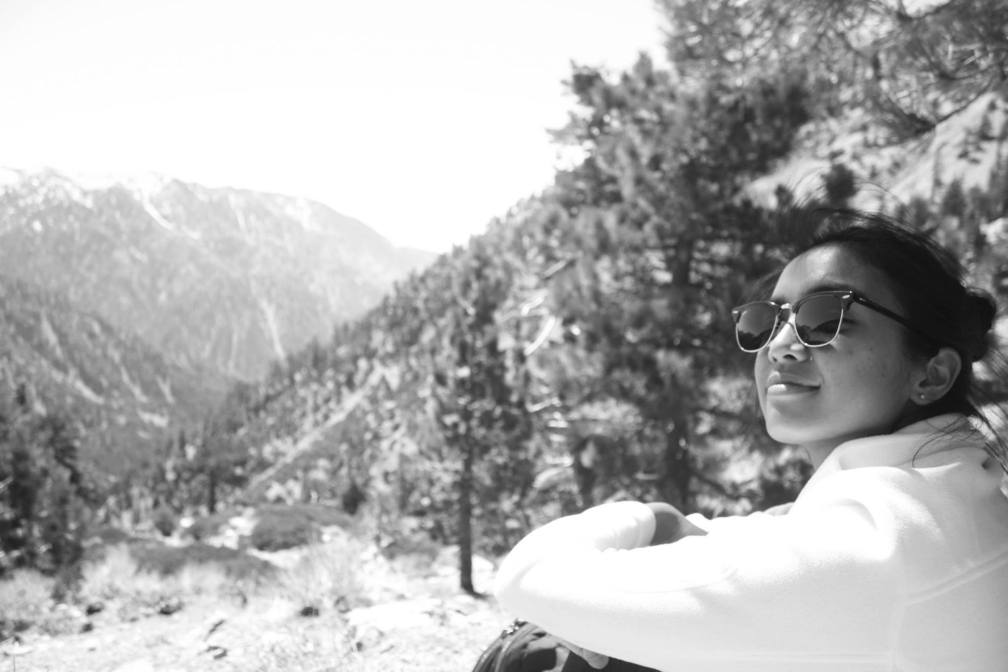
My fitness journey is a continuous process, a lifestyle of always growing and learning. But my fitness journey is not only about fitness. It’s about creating a balance between eating Filipino food with my family (rice forever and always), enjoying chocolate in all of its forms, and making healthy decisions without sacrificing the cultural, social aspects of eating. It’s about finding confidence in myself and loving my body when it is difficult to find women who look like me in the gym or on social media. It’s a journey I try to look at as interdisciplinary, as intersectional. It’s about being inspired and empowered, while hoping to inspire and empower others. I’ve found lots of women of color on Instagram who are my inspiration and who also keep it real when it comes to social issues and representation. But when you search “Asian American fitness,” the top hits are hyper-sexualized stereotypes and fetishes of Asian women and the desexualization, undesirable portrayal of Asian men. There needs to be more content from Asian Americans that tackles these stereotypes head on and addresses the lack of Asian American representation to make it mainstream and frequent. We’re here! Just doing our thing. I’m here to try and be a platform to show one face of #asianamericanfitness. But I’m only just one voice and experience of the huge, super diverse, and move-making group of people!

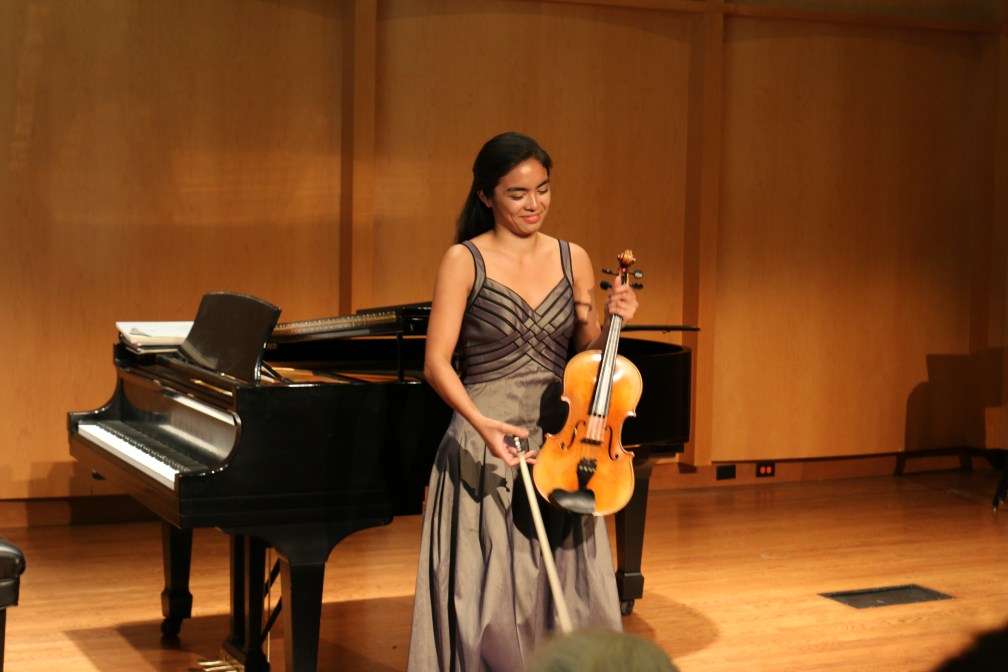
I am very privileged to have gone to schools with great general physical education and athletic resources as well as live a lifestyle now that allows me the leisure time of running races and working out. My foundation and basics about stretching and warming up from elementary through high school years have stuck with me. Unfortunately, as early as this, I also remember becoming fixated on sizes and numbers, that mine were not as small as my peers. I wasn’t aware of why or how I thought this, but it stuck with me. My first official organized sport and athletic extracurricular activity was club volleyball in 6th grade. This was great because I met more girls my age who also had strong thighs. Throughout middle and high school, I did volleyball and track (sprints and hurdles), until my senior year when music took over my extra circulars. (I play viola, and that journey is an interesting one too!)

In my first year of college, despite having access to an absolutely beautiful gym with many diverse resources in an all women’s space, I only ran on the treadmill. I was also intimidated by the machines and weights and anyone using them. Transitioning from high school to college was not easy for me. I didn’t  take care of myself emotionally amidst the social life adjustments and figuring out how to fully manage my own time. Luckily, one of my friends persuaded me to go to my first high intensity interval training (HIIT) class near the end of first-year, which completely changed how I worked out. After that workout, I remember feeling a soreness I had never experienced before, in muscles I never worked out before that point! With this friend and another, our trio regularly went to HIIT Fit and spin classes throughout college in addition to doing workout DVDs such as Jillian Michaels and even P90X and Insanity (these last two did not become regulars). With these two friends, I started running outside, very slowly I might add, trailing behind them since they both had cross country, track, and soccer experience. During my senior year (2015-2016), my suitemates introduced me to Kayla Itsines’ infamous BBG. I worked out irregularly that first semester because of thesis and academic stress. And honestly, I was not investing in myself, I made excuses and let myself slip from even choosing small, healthy options daily. But I got tired of feeling sluggish, mentally and physically, I just had to change something, starting with each day. So during winter break before senior spring, I started BBG with the intention of finishing all 12 weeks. My workouts started at home, with bags full of books as weights. By the middle of senior spring, I was doing BBG  Monday, Wednesday, and Friday, HIIT Fit classes Tuesday and Thursday, and running or cycling Saturday and Sunday — while eating much better. I felt more comfortable in the gym (it’s liberating when you realize most people are doing their own thing and not judging you!), reading how to use the machines, trying out things I looked up online, and talking with the trainers and instructors at the gym.  I have always prided a happy layer on my stomach, but during this period was the first time I had ever seen my abs. I have never struggled with weight, but I was never “toned” nor did I ever have muscles like I did during this period. It was still hard to not compare myself to skinnier, more toned peers. I went through typical college cycles of eating badly under stress, having some weekends of drinking more than I should have, consuming 2-3 cups of coffee a day, and not getting consistent sleep. Yet, my metabolism was very much on my side and the dinning halls made it really easy to eat whole and healthily when I stuck to it. I did not have a “freshman 15” but I certainly wasn’t getting any stronger during that first year. Since graduating, I’ve had to redefine what fitness means to me in a new lifestyle context. I’ve started to reframe my mindset when I start comparing myself to others and to truly start appreciating my body. I’ve also started to question the perceived norm of beauty standards and the language of workouts, especially towards and in regard to women.

In May 2016, I moved from Southern California to Washington, D.C. and to say it was a hard move is an understatement. I didn’t have a job. I hardly knew anyone. I felt trapped in my apartment, anxious and not knowing where to begin with anything. I was scared. In terms of fitness, I stopped working out. I didn’t have money for a gym membership. I became discouraged to run outside because of catcalling. Eventually, I got sick of feeling physically and mentally weak. I remembered when I first started BBG in January 2016, the first time I actually completed the 12 weeks. I remembered back on this time and used it to inspire me to start it up again, doing the workouts in my apartment with a chair as a bench and filled orange juice gallons as weights. I started running outside to discover and get acquainted with the neighborhood and city. The consistency of working out during this time was kind of spotty but in August 2016, I got a Planet Fitness gym membership, using it mainly on weekends because my new job was over 2 hours away by public transportation. I made a resolution for myself to run a half-marathon every 6 months, because why not? Not to mention the ubiquitous amounts runners in DC inspired me to do so. My first half was the Navy-Air Force Half-Marathon in September 2016 (also my first experience with chaffing. I argue it was more painful than the run itself). In December 2016, I got a car and was able to go to Planet Fitness before work and use the gym at my work without worry about transportation timetables. In a typical new years resolution fashion entering 2017, I vowed to use the gym at my work to complete BBG for the second time, and I did so 12 weeks later. In March 2017, I ran my second half-marathon, the Rock n Roll Series Half-Marathon in D.C. Since then, I’ve moved to an apartment with gym in the building and nearby running/bike trails.

Throughout this journey, I’ve gotten better and being more comfortable and confident in my skin, at accepting and embracing different beauty standards instead of riddling myself with constant comparisons about why I don’t look as skinny, as slender, as toned as other women and peers. I still have insecurities so I sometimes still compare myself to others, I’d be lying if I said it never happened. But I’ve gotten much better and quickly reframing comparisons as inspiration and being aware of my own positionality and role in creating an inclusive fitness space.

I’m not a certified expert in fitness, training, or nutrition. My journey is about finding out these things for myself and hopefully inspiring others to try things out for themselves. But this journey is also about being real, about how life isn’t always roses and sunsets. It’s a constant process, it’s being in the present, it’s a practice in visibility and representation at the forefront.

I hope you’ll join me on this journey via my blog and Instagram!
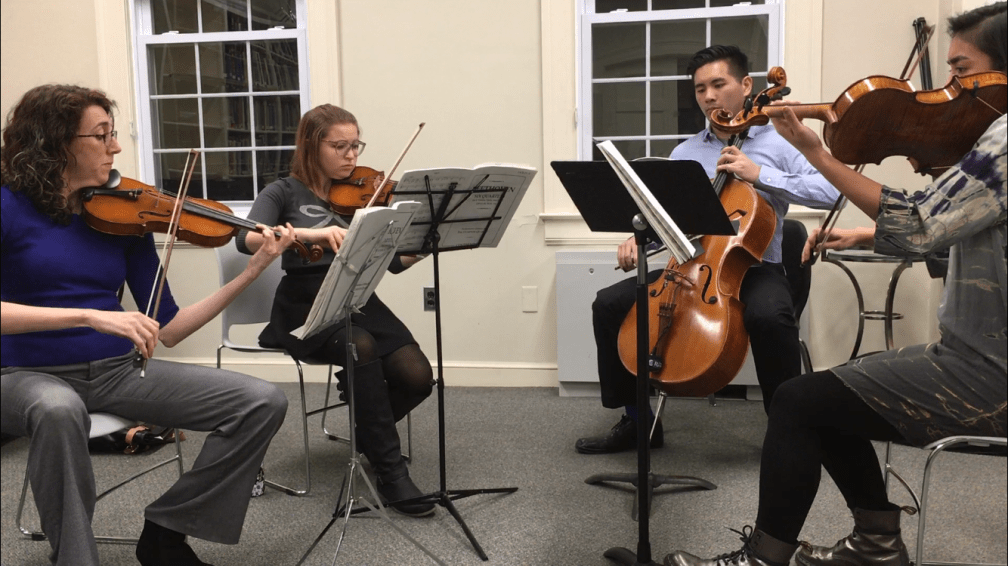
String Quartet No.3 in D Major, Op. 18 by Ludwig van Beethoven (1770 – 1827)

Beethoven arrived in Vienna in 1792 after leaving his hometown of Bonn, Germany. While establishing his career in Vienna, Beethoven wrote many trios and quintets before composing his first string quartet. He seemed apprehensive about writing string quartets because Haydn and Mozart had elevated the genre to a very high level during this time period. Beethoven began studying with Haydn in 1793, mastering counterpoint and studying his and Mozart’s string quartets. Commissioned by the Prince in 1798, Beethoven began work on his first set of string quartets which were later published as Op. 18 in 1801. The set of six quartets were not composed in their published order. Although it is published as No. 3., String Quartet No. 3 in D Major was the first string quartet Beethoven composed.

String Quartet No. 3, Op. 18 illustrates Beethoven’s understanding of the form as established by Haydn and Mozart. The work also demonstrates Beethoven’s musical maturity, using development, modulation, texture, and a sense of emotion that sets him apart from his predecessors. The first movement, Allegro, begins with a slow, two-note figure which sounds like an introduction. Yet, these two notes serve as the main motif throughout the movement. Beethoven develops the motif into different chordal, contrapuntal, rhythmic, and tempo characteristics which still derive from the original idea. The second movement, Andante,  begins in a key uncommon for the time with a peaceful, walking melody and texture. It gradually progress into darker harmonic territory and underlying syncopation with much less resonant closure before returning to an iteration of the opening material. The third Allegro movement is effectively written as a minuet and trio, but Beethoven seems to challenge the form by inserting a “minore” section and marking the movement at a faster tempo than what would be used for a minuet. The third movement is sprinkled with unexpected increases and decreases in volume as well as a cheeky, light-hearted ending. In the final movement, Presto, Beethoven begins with a jaunty, dance-like tune in the first violin. The movement follows sonata form, developing the main through fragment pieces each played by a different player. After restating the main theme, the movement ends cheerfully, punctuated by a two short, soft fragments of the rhythmic theme.

Francesca Jimenez, Senior Viola Recital

Suite No. 3 in C Major, BWV 1009 Johann Sebastian Bach (1685 – 1750)

Suite No. 3 in C Major is one of six suites for unaccompanied cello composed between 1717 and 1723. Bach composed these pieces while serving as Kapellmeister in Köthen in northeast Germany. New instrumental genres had been emerging during and prior to this time. Such genres include the Allemande, Courante, Sarabande, and Gigue – stylized dances that were presented together as a suite.

The Prelude embodies an improvisatory, free-flowing texture. The consistent nature of fast moving passages is typically phrased through rubato, from Italian meaning “robbed or stolen time.” Time is “robbed” or slowed down at the end of phrases and repositioned in new beginnings with more rhythmic energy. The Prelude from Suite No. 3 ends with an extended cadential sequence of 4-stringed chords.

The Allemande, which is the French word for “German,” is usually in a moderate 4/4 meter characterized by continuous rhythmic activity and a recurrent pick up note. Although the Allemande of Suite No. 3 is notated in 16th and 32nd notes, the feel is light and sauntering.

The Courante, French for “running” or “flowing,” is structured as a triple or compound metered dance. The Courante of Suite No. 3 is comprised of continuously running 8th notes driven further by constant melodic development. Between longer phrases and the endings of sections¸ slightly more sustained notes punctuate moments of rest before the repeating.
The Sarabande originated as a quick dance song from Central America to Spain and Italy. As it spread to France and other areas of continental Europe, the Sarabande also took on a slower form characterized by rhythmic hemiolas.

The Bourrée originated as a French folk dance. Bourrée I of Suite No. 3 is quick and light in tempo. The opening phrases illustrate a clear antecedent-consequent structure, a type of call and response using the same rhythm. Bourrée II, in C Minor, is a sorrowful departure from the light character of Bourrée I. The Bourrée II is slower, yet still maintains forward movement through the same rhythmic structure as Bourrée I.

The Gigue originates from the jig of the British Isles. The term gigue originates from the French word “giquer” which means frolic or leap. Additionally, the Italian style gigue, or Giga, is rapid in tempo and characteristically spirited. Bach adapts this lively style in the gigue of Suite No.3 through metering in 3/8 time.

Divertimento in D Major by Franz Joseph Haydn (1732 – 1809)

Franz Joseph Haydn served nearly 40 years as court composer for the Esterhazy family in Austria. During this time, he composed 175 pieces for his patron, Prince Nikolaus Esterhazy, an avid player of the viola da gamba and the baryton, thus creating a large amount of baryton music. Much of the repertoire that Haydn composed for these instruments, however, was destroyed during a fire. The viola da gamba and baryton were part of the viol family, bowed, stringed, fretted instruments that emerged in the 15th century and remained in regular use until the end of the 18th century. The viola da gamba was referred to as a viol because of its melodic function and unique, aesthetically pleasing tuning. The baryton was a type of bass viol with six or seven strings and a separate set specifically for plucking. Viols had flatter backs than modern day cellos. They were held upright between the player’s knees and bowed underhand with the performer’s palm facing upwards. Haydn composed for 175 pieces for baryton trio. 126 of these are scored for viola, cello, and baryton. In 1944, Russian-born American cellist Gregor Piatigorsky drew from three of these trios arranged them into this divertimento for cello and piano. William Primrose, a prominent Scottish violist, transcribed Piatigorsky’s arrangement for viola and piano. Primrose’s arrangements highlight the soloistic capabilities of the modern viola.

The first movement, Adagio, is sonorous and lullaby-like with two mirroring sections. The light-hearted Menuet, a relative of the Baroque dance forms featured in Bach’s suites, gestures playfully with an ornamented opening and a sequence of coupled 8th notes. These coupled 8th notes continue throughout the Trio. They are longer barred as couplets, suggesting longer phrases. The last movement, Allegro di molto, draws from the playful character of the Menuet and Trio. A fast-paced 4/4 meter propels the movement forward, with 16th note runs interspersed with slurred and dotted 8th note phrases. The last movement climaxes on a dominant chord before the recapitulation, ending on grand, full quarter note D Major chords.

From My Garden b Ursula Mamlok (b.1923)

“My main concern is that the music should convey the various emotions in it with clarity and conviction. It interests me to accomplish this with a minimum of material, transforming it in such simple ways so as to give the impression of ever-new ideas that are like the flowers of a plant, all related yet each one different.”
– Ursula Mamlok

Ursula Mamlok was born in Berlin and educated at the Manhattan School of Music. Her compositional language draws from diverse styles; American minimalism, on the one hand, and serialist techniques associated with the Second Viennese School, on the other. Her works are through-composed, meaning that each line of music is new and carefully tailored. Her meticulousness prevails throughout her works. Critics note that there is nothing unnecessary in her compositions.
Mamlok composed From My Garden in 1983 and dedicated it to her husband, Dwight Mamlok. The piece is inspired by the summers they spent in his hometown, San Mateo, California to escape sweltering New York heat. The work illustrates the diverse nature in California, from lush redwoods in the Bay Area to the desert chasms of the San Andreas Fault. In From My Garden, Mamlok aimed to bring together two traditionally incompatible compositional systems by creating an aesthetically tonal piece that incorporates atonal, serial techniques. She utilizes the 12-tone system, which is based on multiple transformations of a tone row containing the 12 pitches of the chromatic scale. The row for the piece is as follows: D-B-F-G#/Ab-G-Bb-F#-C-C#-E-D#/Eb-A. Transformation techniques include presenting the original row in reverse order or inverting the intervals. Although serial techniques and the concept of a tonal center are very often mutually exclusive, Mamlok organizes From My Garden around a tonal center––the note D, her husband’s first initial.

The piece begins in a very meditative character, with D harmonic pizzicatos and droning. Increasingly, Mamlok introduces quick, disruptive ornaments to the sustained notes. The ornaments are fragments of the 12-tone row, revealed bit by bit, disrupting the meditative long notes with rhythmic, dynamic, and tonal dissonance. Gradually, the ornaments become more eruptive lines that rise and fall abruptly as transformations of the row. In an interview with the San Francisco Chronicle from 1989, Mamlok describes the slow starting, disrupting, and accelerating nature of the piece as a depiction of earthquakes caused by tectonic plates. Dynamics are much more intense and varied throughout this middle section, as are bowing and pizzicato techniques. For instance, Mamlok notates a “Bartók pizzicato,” a technique that calls for the player to pull the string with enough force to create a snapping sound against the fingerboard. This technique was popularized by the notable 20th-century Hungarian composer. Mamlok also includes left hand pizzicatos, allowing the player to bow and pluck simultaneously. She also uses tremolos, fast, unmetered bowings, for a dramatic, trembling effect. To create an ethereal effect, Mamlok calls for the violist to bow at the bridge, a technique called sul ponticello. The ending of the piece mirrors the beginning––long tones are held on the note D, now incorporated with double stops that are the subsequent notes of the original row. The piece ends with a serene meditation on the note D created through harmonic pizzicatos.

Piano Quartet No. 3 in C Minor, Op. 60 by Johannes Brahms (1833 – 1897)

Brahms completed his last Piano Quartet No. 3 in C Minor, Op. 60 in 1875 after years of the piece remaining unfinished. He first showed the work in the 1860s to his biographer Hermann Deiters saying: “Imagine a man who is just going to shoot himself, for there is nothing else to do.” In conversations with his publisher Nikolaus Simrock, Brahms also compared the overall emotional expression of the quartet with the anguish of a man contemplating suicide. In further conversations with his publisher, Brahms implied that the piece musically depicts Goethe’s work The Sorrows of Young Werther, a story about a young man who shoots himself because he is in love with a married woman whose husband he admires. Thus scholars also refer to the piece as the Werther Quartet. Although Brahms never explicitly identified himself with Werther, scholars have drawn a parallel between Goethe’s character and Brahms because of the deep emotional connection he had for Clara Schumann, wife of composer and pianist Robert Schumann. His close relationship with the Schumanns took a drastic turn after Robert’s death. Although Brahms never admitted to have been in love with Clara, it is clear that he harbored an immense amount of feelings toward her. The love and respect that Brahms felt for Robert before and after his death, however, prevented him from ever betraying his romantic connection to Clara.

I. Allegro non troppo The movement begins with punctuated piano chords, followed by slow, aching chord swells played by the strings. This chord swells erupt into a 16th-note passage played in unison. The music of the first movement reflects the emotional struggle of Werther, and arguably also that of Brahms. This struggle is further contrasted against melodic themes that are first presented in the major mode but eventually stated in a minor key. “Werther’s battle” has knightly moments of victory as marked by unison chords with the piano, violin, and cello while the viola gallops forward with 16th notes. However, these moments of victory are quickly overcome by a developmental fugal section in which our protagonist is thrust into tumultuous emotions yet again. This dichotomy of triumph and disdain persists throughout the movement, ending upon a C minor chord swell reminiscent of the opening.

II. Scherzo Allegro The piano first introduces a motif consisting of an upbeat 8th note leading to a long note, prefacing the staccato texture of the movement. The piano statement is answered by the strings. Throughout most of the movement, the strings are often in unison, while the piano remains largely independent. This separation could be interpreted as a representation of the conflicting interests of Brahms’s own inner emotional struggle. At times, all four parts interact in rhythmic ways. Instead of playing together, the instruments seem to be playing against each other. Brahms writes this as the simultaneous sound of duple subdivisions against triple subdivisions of the main beat. Before the recapitulation of the first theme, this antagonistic dynamic is the most evident. The violin, cello, and piano have the same rhythmic motif, but each part enters independently on a weak beat of the measure. Repeating 8th notes in the viola harmonically and rhythmically drive the ensemble into the unison iteration of the opening fragment. The piece ends in a climatic string trill and complete ensemble tutti for the final chords.

III. Andante The cello opens the movement with an extended, lyrical melody accompanied by the piano. The Andante can be interpreted as an unrequited love song because of its constantly building main melody. This main theme perpetuates through the movement as it is passed like a linking motif between each of the ensemble members. Unlike the antagonistic nature of the second movement, the melodic interplay of the Andante incorporates the nostalgia and longing characteristic of 19th-century romantic music through fragmentary links of the melody. These melodic and counter melodic motifs delay harmonic resolutions; thus beginnings of contrasting sections act like extended deceptive cadences for one another instead of providing a sense of closure. At the beginning of the recapitulation, the pianist plays the original melody accompanied by pizzicato and rhythmic motifs. The movement ends with the melody in the cello hinging upon the last note of the phrase, answered by the piano and followed by ascending pizzicatos on the final cadence.

IV. Finale: Allegro comodo The last movement begins with a violin solo accompanied by the piano. Throughout the movement, Brahms composed several string “chorales,” which demonstrate his affinity with 18th-century practices as well as Mendelssohn’s lasting influence. The swelling long notes sound in contrast with the triplet, rippling motifs in the piano. Similarly to the second movement, Brahms juxtaposes the piano and strings in strong rhythmic contrast of duple and triple subdivisions of the beat. Throughout the middle section, Brahms develops fragments from the initial theme as slurred motifs relayed between violin and viola. The main theme reappears in the strings as a final and dramatic declamation. Again, the pianist leads the quartet through the final section of the movement with declamatory C Major chords, reminiscent of church bells. The piece ends with descending fragments of the main theme played by the violin and viola with a sustained cello drone and chromatic scales in the piano. The quartet ends with a Picardy third, an unexpected C Major chord closing a movement that was predominantly in C Minor.